How Many People Die From Generator Carbon Monoxide Poisoning?
By the Generator Size Calculator Team · Updated · 5 min read
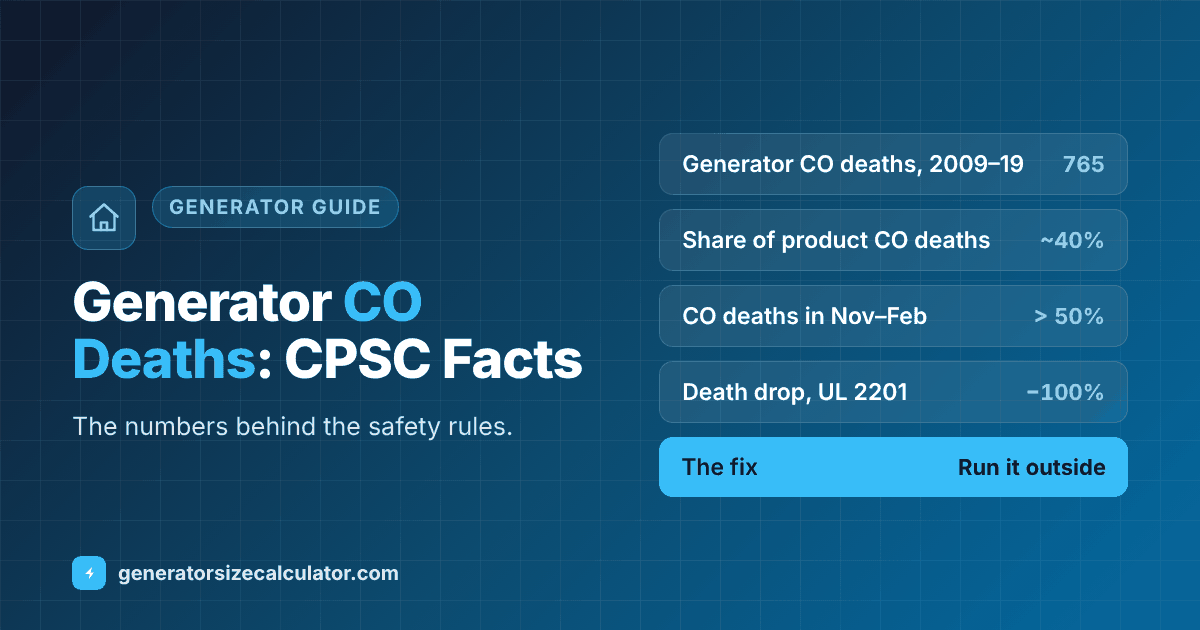
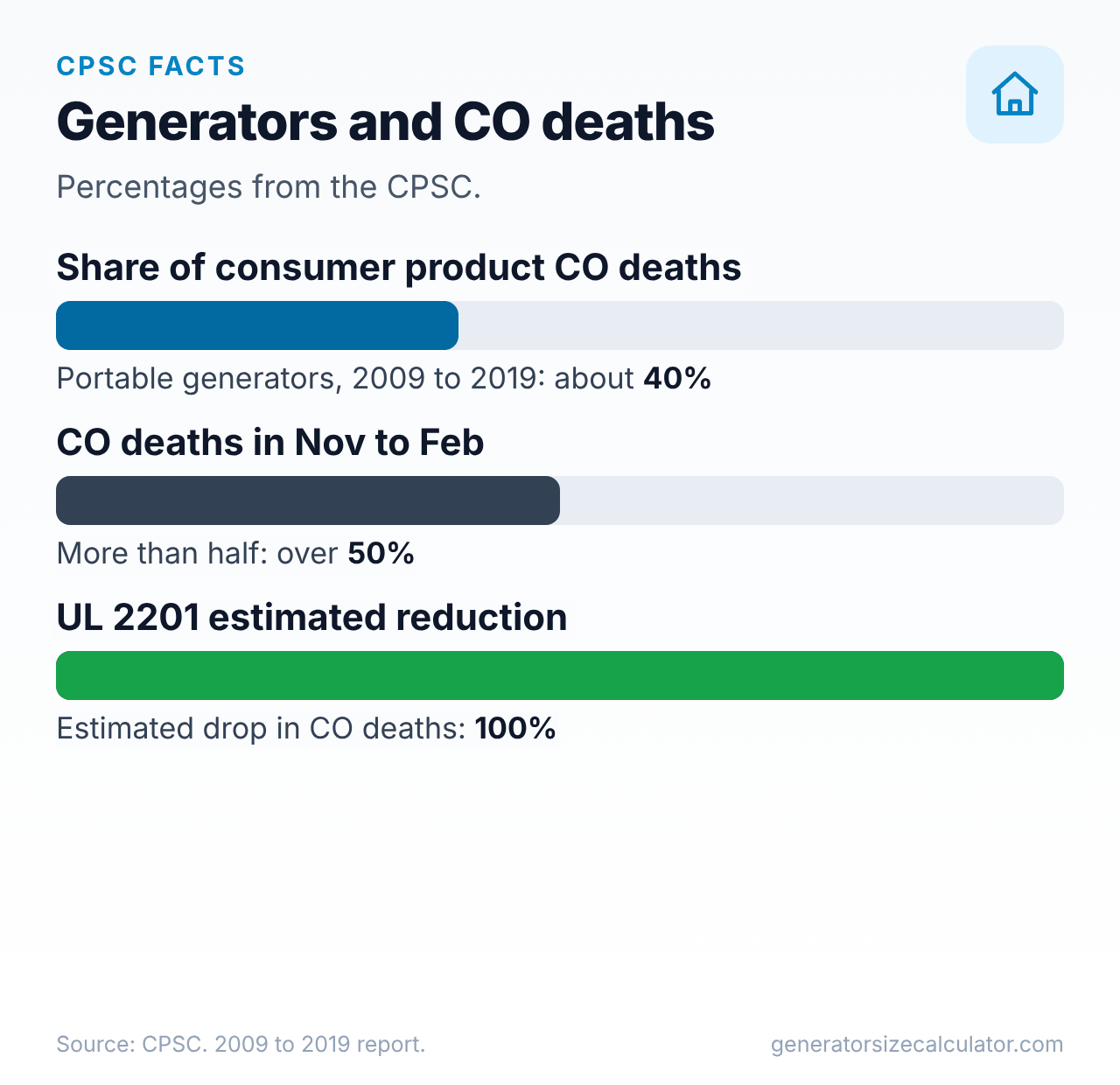
Quick answer: In its report covering 2009 to 2019, the CPSC estimates that portable generators were associated with 765 non-fire carbon monoxide poisoning deaths, about 40% of consumer product CO deaths under its jurisdiction. It estimated 250 consumer product CO deaths in 2019, the highest year in the report, and says more than half of CO deaths happen in November through February. Almost all of these deaths are preventable.
The CPSC numbers
| Fact | CPSC figure |
|---|---|
| Non-fire CO deaths linked to portable generators, 2009 to 2019 | 765 (estimated) |
| Share of consumer product CO deaths under CPSC jurisdiction | About 40% |
| Consumer product CO deaths in 2019, the highest year in the report | 250 (estimated) |
| Heating systems, second-largest cause in 2019 | 69 deaths (28%) |
Engine-driven tools, which include generators, had the largest share of non-fire CO poisoning deaths in 2019, according to the CPSC.
When it happens
The CPSC says more than half of CO deaths occur in the four cold months of November, December, January and February. That is when winter storms cause outages, and when people close up the house, so exhaust can drift in or a generator gets moved into a garage to keep it dry or warm. This is why the placement rules matter most in winter.
How to prevent it
- Run it outside only, at least 20 feet from the home, with the exhaust pointed away. See can you run a generator in a garage.
- Install CO alarms on every level and outside bedrooms. See CO alarms and generators.
- Buy a model with a CO shut-off certified to PGMA G300-2018 or UL 2201. See what a CO shut-off is.
- Maintain the generator and follow the labels and owner's manual.
- Consider a battery power station for small loads. See the portable power station calculator.
About these numbers
These figures come from a CPSC report covering 2009 to 2019 and are estimates. More recent CPSC reports may show different totals, so check the CPSC's current publications for the latest year. The pattern, though, has been consistent: deaths come from running generators in or near enclosed spaces.
Check cord length and loads before the next outage.
Never run a generator in a home, garage, basement, crawlspace or shed. Carbon monoxide has no smell or color. If a carbon monoxide alarm sounds, or anyone feels dizzy, has a headache or feels sick while a generator is running, get to fresh air and call 911. See how far a generator should be from your house.
Frequently asked questions
How many people die from generator carbon monoxide each year?
The CPSC estimates 765 non-fire CO deaths linked to portable generators over 2009 to 2019, so about 70 a year on average. Totals vary by year.
What share of CO deaths involve portable generators?
About 40% of consumer product CO deaths under CPSC jurisdiction from 2009 to 2019.
When do most CO deaths happen?
More than half occur in November, December, January and February, according to the CPSC.
Are these deaths preventable?
Yes. Running the generator outdoors, far from the home, with working CO alarms prevents them.
Does a CO shut-off reduce deaths?
The CPSC estimates that generators certified to PGMA G300-2018 and UL 2201 would reduce CO poisoning deaths by 87% and 100%.
Related calculators
Sources: U.S. Consumer Product Safety Commission, portable generator safety and carbon monoxide statistics (2009 to 2019 report: 765 deaths, about 40%, 250 deaths in 2019, heating systems 69 deaths or 28%, more than half of deaths in November through February). The average of about 70 a year is simple division of 765 by 11 years.